DATA PROTECTION
Zero Trust and Immutable Cloud Storage: The Circle of Trust is Gone
Once upon a time, in a data center not that far away, users could log in via a VPN and have access to all of the applications and data inside the corporate network. Life was easy. Then, one miserable day, a group of malicious hackers broke into the corporate network via malware, compromised the network, stole data, and deleted the local backups. To make matters worse, they installed ransomware that encrypted the on-premises applications and data, bringing the targeted company to their knees until the ransom was paid. Life was not so easy anymore…
The circle of [IT systems] trust has been shattered forever.
From our friends at NIST –
“A typical enterprise’s infrastructure has grown increasingly complex. A single enterprise may operate several internal networks, remote offices with their own local infrastructure, remote and/or mobile individuals, and cloud services. This complexity has outstripped legacy methods of perimeter-based network security as there is no single, easily identified perimeter for the enterprise. Perimeter-based network security has also been shown to be insufficient since once attackers breach the perimeter, further lateral movement is unhindered.”
Understanding that the nature of IT systems security has forever changed, let’s talk about Zero Trust and how it helps to combat this constant threat.
Zero Trust is not necessarily a new concept. It has been adopted by a number of organizations that were among the first to recognize that a less trusting model of security was required to operate in the internet-connected cloud age. I’ll go back to NIST one more time – “Zero trust (ZT) is the term for an evolving set of cybersecurity paradigms that move defenses from static, network-based perimeters to focus on users, assets, and resources.”
Simply translated: just because you can access the corporate network doesn’t mean you have access to any or all of the corporate resources – applications, databases, systems, or data. In fact, when you bring the Principle of Least Privilege into the equation, as a new employee/contractor you start off with NO access to anything and slowly qualify for limited access to only those resources absolutely necessary for you to do your work. It sounds complicated and labor-intensive. It can be, but the alternative is spending 10-100x more money and time trying to recover from a breach or ransomware attack.
So where does immutable storage come into the zero trust equation?
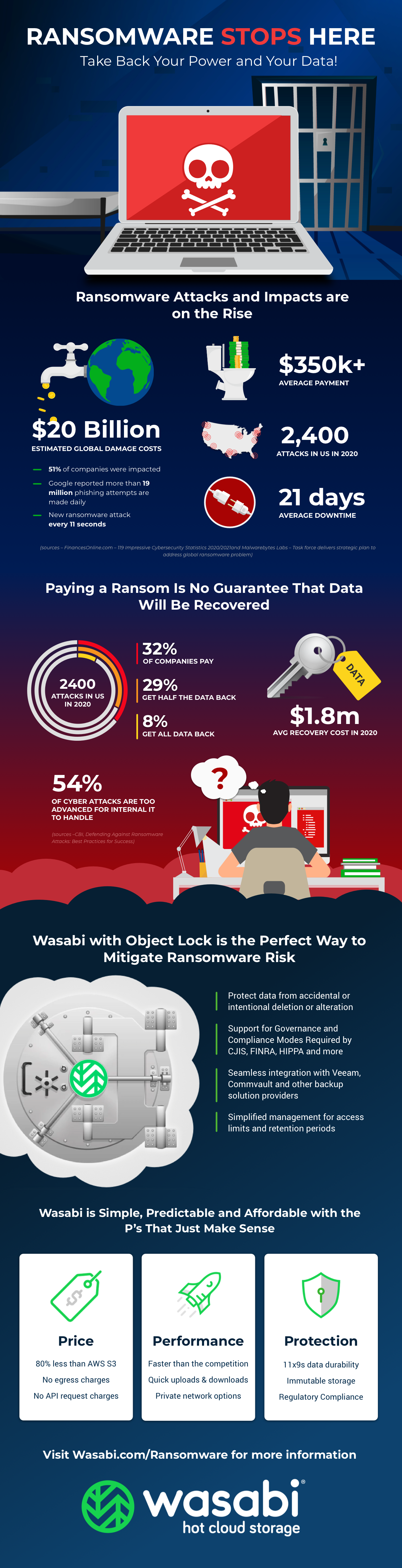
As we’ve been discussing for the past 6+ months here, and here, immutable cloud storage is the air-gapped failsafe that protects your application and data backups from bad actors and ransomware. It also protects you from accidental PEBKAC* moments as well as disgruntled employees/contractors. Immutable storage cannot be deleted, modified, or re-encrypted (it is already encrypted when it is stored in the Wasabi system) without Root access to your account. As long as you are using good procedures for managing access to your Root account, including Zero-Trust standbys like single sign-on, multi-factor authentication, and application-specific IAM users with the least privilege, the Root account is safe as is your account and data.
If you’re a curious, life-long learner like all of us at Wasabi, I encourage you to read up on the topic of Zero Trust here, here, or here and see for yourself how the circle of trust has changed. I think you’ll find that implementing capabilities like immutable cloud storage has become imperative for securing your backups.
*PEBKAC – problem exists between keyboard and chair; a common diagnosis for trouble tickets asking “Where is the ‘any key’?”.
Related article
&w=1920&q=75)
Most Recent
Two AI storage quotes can match on price per TB and still produce very different bills. See where the fees hide, then model your own workload.
Ransomware can send a hospital back to paper. Learn how immutable backups and tested recovery help healthcare IT teams restore faster without paying a ransom.
Learn why AI workloads demand a different storage model: no egress fees, true data mobility, and room to scale without penalty.
SUBSCRIBE
Storage Insights from the Storage Experts
Storage insights sent direct to your inbox.